East Facing or West Facing: What Actually Changes
Most Indian buyers ask about facing first and examine it least. Three quite separate arguments are bundled into the question, one about daylight and heat, one about tradition, and one about money, and they usually come out as a single verdict. Separating them is worth the effort, because only one of the three is measurable, only one is a belief, and only one will appear on your cost sheet.
A definition first, because this is a real source of confusion. A plot's facing is taken by convention from the direction the plot's main frontage and entrance face: an east-facing plot has its access road to its east and its front door opening eastward. Other people describe facing by the direction you look when you walk out. Before you accept anyone's description, look at the key plan and find north.
The Daylight and Heat Argument
At roughly 13° north, Bengaluru has the sun tracking high overhead for much of the day, so the difference between orientations is felt mainly at the two ends of it.
An east frontage takes the morning sun. Front rooms brighten early and warm gently, and the sun has moved off that face by late morning. The practical consequence is that an east-facing front room is comfortable through the afternoon and cool by evening. The cost is direct low sun into east windows early in the day, which some people love and light sleepers do not.
A west frontage takes the late-afternoon sun, and of the two orientations it is the one that really alters how a house feels. A low sun late in the day meets west-facing walls and glazing almost head-on instead of glancing off them, so the energy is absorbed by the masonry and given back slowly. Hence a west-facing bedroom that is still warm at bedtime, hours after sunset. None of that is serious in Bengaluru's climate, it is a question of comfort, but it does explain why rooms on the west carry higher cooling loads.
A west-facing villa is not a bad house because of any of that. It is a house with a design problem, and the problem has known answers: insulation in the western wall, external shading, deeper overhangs and projections on the west face, trees or a screen on that boundary, fewer or better-specified windows to the west, and the rooms you use in the evening placed away from that face. If a west-facing plot is in front of you, ask what is being done about it, and ask to see the elevation and the window schedule on the western side.
Two things matter more than facing and get discussed less. One is cross-ventilation, which depends on windows in opposite walls rather than on which way the front door points. The other is the top floor: in a G+2 villa the fully exposed second-level terrace takes far more solar gain all day than any vertical wall does at any hour, whichever way the house faces.
What Vastu Convention Holds
This is reported as convention, since that is all it is: a belief system about orientation, traditional, widely held in India, and not a body of measurement.
In vastu shastra the east is generally treated as the most auspicious frontage, linked with the rising sun, renewal and vitality, and east-facing homes are the ones most often recommended, with north-facing usually placed alongside. West-facing homes are not held to be inauspicious in themselves: practitioners commonly hold that a west-facing house is compliant provided the main entrance, the kitchen and the master bedroom are correctly placed within it, and such houses are sometimes described as suiting particular temperaments. Practitioners differ, and any specific reading of a plan is a matter for the person you consult, not for a web page.
Belief has commercial consequences, which is why a marketing page cannot simply set this aside. Whether or not you personally weigh vastu, a large enough share of the resale market does to affect how quickly a home sells and to whom. That is a fact about the market, and it is the bridge to the third argument.
The Commercial Argument: Facing Costs Money
Developers price east-facing frontage because it is in demand. Buyers most often discover this part late, and it is not a small line.
The structure at Nambiar Beverly Green is explicit, and the premium is a lump sum attached to the plot rather than a change in the rate. West-facing non-corner plots carry no preferential-location charge, so they are what set the "from" price of ₹5.48 Cr. East-facing plots carry a preferential-location charge equal to their development and infrastructure charge; an east-facing corner 40 × 63 carries it twice over, ₹46.27 L, and that is where the ₹7.29 Cr top of the range comes from.
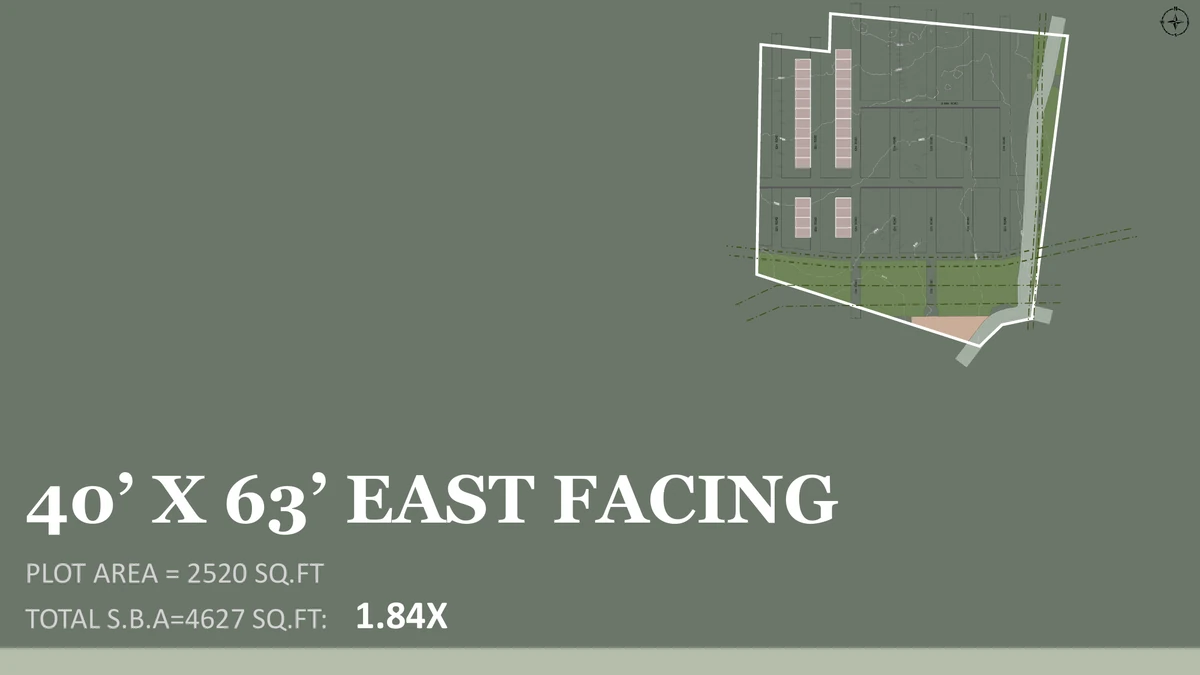
Saleable area is not identical across orientations either, which is a second and smaller difference. West facing, a 35 × 55 measures 3,732 sq.ft.; east facing, 3,782 sq.ft. West facing, a 40 × 63 measures 4,638 sq.ft.; east facing, 4,627 sq.ft. Because the plans are mirrored and re-planned rather than simply flipped, compare the actual plan for the orientation you are considering instead of assuming symmetry.
Neither orientation is scarce here, so the choice is a genuine one rather than something you are forced to pay for. Phase 1 splits broadly evenly between the two: of the 135 plots at 35 × 55, 68 are east facing and 67 west; of the 59 at 40 × 63, 30 are east and 29 west. All prices are indicative and subject to change.
How to Decide
- If you hold vastu views, or expect to sell to someone who does, the east premium is buying you something real in resale terms. Pay it knowingly.
- If you do not, a west-facing plot is very often the same house, in the same community, for materially less money, with a heat problem that shading and planting can largely answer.
- Judge the specific plot, not the compass point. A plot's neighbours, the road width in front of it, whether anything overlooks the terrace, and where the open ground is affect daily life more than facing does.
- Get the premium itemised. Ask which attribute triggered the charge, orientation, corner, frontage, and the amount attributable to each, in writing, before you decide the premium is worth it.
Where to Go Next
PLC and facing premiums explained covers how preferential-location charges are built and how to get them itemised. Areas by configuration for Nambiar Beverly Green are on the villas page and the cost stack on the price page. The blog indexes the other explainers.
Explore Nambiar Beverly Green