Nambiar Beverly Green Cost Sheet
One villa, one number: that is what a cost sheet does with the published rate at Nambiar Beverly Green. Four steps get it there. The sheet begins with ₹13,499 per sq.ft. applied to the saleable area of the villa; it adds the development and infrastructure charge attaching to that plot; it adds a preferential-location charge if the plot attracts one; and it puts 5% GST on the total of those. Out of that come the figures the price page publishes, from ₹5.48 Cr for a 35 × 55, from ₹6.82 Cr for a 40 × 63, within a Phase 1 band of ₹5.48 Cr to ₹7.29 Cr. All of it is indicative, pre-launch and open to change.
Where buyers most often go wrong is the sequence. The infrastructure and location charges go in first; GST lands last, on the base sale value after those charges have been added. So both are already inside the published figure rather than stacked on top of it. A ₹5.48 Cr villa is ₹5.48 Cr with its development and infrastructure charge and its 5% GST counted in. Read them as extras and you have overstated the villa by something like ₹19 lakh to ₹23 lakh.
Then check which area the rate has been applied to, the second test to run on any sheet put in front of you. ₹13,499 is charged against saleable area, which runs 3,732 to 4,638 sq.ft. across the four variants, and not against the 1,925 or 2,520 sq.ft. of land underneath. What is being sold is a finished G+2 villa, handed over built; the plot dimension simply describes the parcel it stands on. Between the two measures lies close to a factor of two, worked through in saleable area against plot area.
Budget separately for three heads the sheet total never covers: registration, stamp duty and maintenance. The first two are paid at whatever rates the Government of Karnataka has notified on the day the sale deed is registered. Maintenance runs at ₹48 per sq.ft. for the first year, 18% GST included, and a maintenance deposit of the same amount is collected alongside it.
What a Cost Sheet Contains
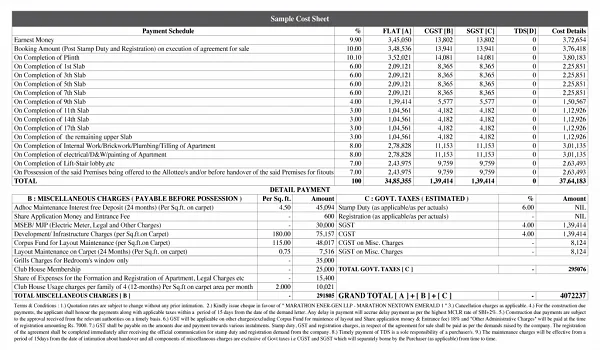
Five heads make up a villa cost sheet here. Four of them build the number. The fifth sets out what the number has been drawn to leave out.
1. Base rate on saleable area
Line one is nothing but multiplication: saleable area × ₹13,499. On the 35 × 55 that area is 3,732 sq.ft. west facing and 3,782 sq.ft. east facing; on the 40 × 63 it is 4,638 sq.ft. west facing and 4,627 sq.ft. east facing. Because east and west villas follow different plans, the areas diverge slightly and this line moves with them. Nowhere else on the sheet does the rate appear.
2. Development and infrastructure charge
Nothing inside the house is paid for by line two. It buys the layout-level work the villa depends on: internal roads at 12 m and 12.19 m, secondary roads at 9.14 m, the entrance plaza and bus bay, and the services routed to each plot. The amount is struck per plot at ₹18.66 L to ₹23.19 L and scales with the land, so a 40 × 63 carries more of it than a 35 × 55. Expect it on the sheet as a rupee figure, never as a percentage.
3. Preferential-location charge
Only plots with an advantage of position reach line three, which runs from ₹18.66 L to ₹46.27 L. What mostly drives it is facing. An east-facing plot carries a preferential-location charge equal to its own infrastructure charge; double that on an east-facing corner plot and you have the ₹7.29 Cr top of the Phase 1 band. West facing and away from a corner, the charge is nil, which is exactly why west-facing villas set the "from" price. Even at nil the line should still be printed.
4. GST at 5%
Add the three lines above and line four puts 5% GST on the sum. The sale is taxable because what changes hands is a built villa rather than a bare land parcel, and residential construction of this kind attracts 5% without input tax credit. The base sale value as a whole is what GST is computed on, so it falls on the infrastructure and location charges just as it falls on the rate line. Every figure published on this site already includes it.
5. What the sheet leaves out
Underneath the total, a properly drawn sheet names the exclusions. Registration and stamp duty come first, payable at the rates notified by the Government of Karnataka on the date of registration. Then maintenance, at ₹48 per sq.ft. for the first year inclusive of 18% GST, with an equal maintenance deposit beside it. Both maintenance heads are computed on saleable area, which means they track the villa rather than the land. Head by head, they are explained on charges and GST.
Reading the Sheet Line by Line
Set out below is the line order on the smallest footprint. The 35 × 55 west-facing villa is used because a west-facing non-corner plot attracts no preferential-location charge, which leaves the structure at its plainest. Read it as a demonstration of how the lines stack, not as a quotation for any particular plot.
- Saleable area, 3,732 sq.ft. on a 1,925 sq.ft. plot
- Base rate, 3,732 × ₹13,499 = ₹5,03,78,268
- Development and infrastructure charge₹18,66,000
- Preferential-location charge, nil on a west-facing non-corner plot
- Base sale value₹5,22,44,268
- GST at 5%₹26,12,213
- Indicative total₹5,48,56,481, published as from ₹5.48 Cr
Reading it in that order settles two points. First, ₹18.66 L belongs inside ₹5.48 Cr and should never be added to it a second time. Second, because the infrastructure charge forms part of the base sale value, GST is computed on ₹5.22 Cr and not on ₹5.04 Cr. Any sheet that taxes the rate line alone has been drawn wrongly.
An east-facing plot uses the identical structure with one further line completed, and it is the preferential-location charge that separates two villas of near-identical size. No other item explains as much of the gap when two buyers in the same footprint compare quotations several tens of lakh apart.
How the Starting Figures Work
These are starting figures per footprint, rather than a plot-by-plot sheet. K-RERA registration for this project has not yet been issued and the project remains pre-launch. Ahead of that grant, nothing published by us or by anybody else is a legally binding statement of area, charge or timeline. A priced schedule of 298 plots issued now would put numbers in front of people with nothing yet standing behind them.
Then there is what the document itself is for. A cost sheet is an internal booking document: one unit at a time, naming a plot number, its exact areas, its exact infrastructure and location charges, and the payment terms attaching to it. It goes to a named buyer for a named plot, it carries a date, and a rate revision by the developer supersedes it. It was never a price list and was not drawn to be published as one.
What this page gives you instead is the structure and an honest bracket. ₹13,499 per sq.ft. on saleable area. Development and infrastructure charge of ₹18.66 L to ₹23.19 L. Preferential-location charge of ₹18.66 L to ₹46.27 L where a plot attracts one. 5% GST inside the total. A Phase 1 band of ₹5.48 Cr to ₹7.29 Cr. That is enough to judge whether a villa here falls inside your range, and enough to test any sheet you are handed for internal consistency.
The moment K-RERA registration is granted it becomes the binding source for areas, charges and timelines, and whatever sheet you hold should be read against the registered documentation. Check the current status yourself at rera.karnataka.gov.in. Until that registration is in place, commit no money.
Getting the Current Cost Sheet
Buyers who register their interest are sent the current cost sheet for the footprint and facing they are looking at. Tell us the variant, 35 × 55 or 40 × 63, east or west, and our team will send the figure as it stands that day, with the infrastructure charge and any preferential-location charge itemised for the plot.
Whatever arrives should be read as an indicative marketing reference with a shelf life rather than a quotation held open, because the project is pre-launch. Rates can change, and registering interest creates no right over any particular plot.
Frequently Asked Questions
1. What is on a Nambiar Beverly Green cost sheet?
A four-line build-up, then the exclusions. Saleable area × ₹13,499; the development and infrastructure charge; where the plot carries one, a preferential-location charge; then 5% GST on those three added together. Below the total come registration, stamp duty and maintenance.
2. Are the development and infrastructure charges extra, on top of ₹5.48 Cr?
No, they sit inside it already. Both the development and infrastructure charge and the 5% GST are counted into the quoted figures. What is payable over and above is registration, stamp duty and maintenance, and nothing else.
3. Why is there no plot-by-plot price list?
Two reasons. The project is pre-launch, with K-RERA registration applied for and approval expected by 20 August 2026. And a per-unit cost sheet is an internal booking document raised for a named buyer against a named plot, not a published price list.
4. Why do two villas of the same size carry different prices?
Position and facing account for it. A west-facing non-corner plot carries no preferential-location charge, which is what makes it the "from" figure; an east-facing plot carries one equal to its infrastructure charge, and an east-facing corner plot double. Saleable areas also differ slightly.
5. Is GST charged on the infrastructure charge as well?
Yes. The base sale value as a whole is what carries GST at 5%, rate line, development and infrastructure charge and any preferential-location charge together, rather than the rate line on its own.
6. How current is the sheet I would receive?
Only as current as the day it is issued. Rates are indicative and can change while the project is pre-launch, with K-RERA registration applied for and approval expected by 20 August 2026, so treat no figure on it as held open or legally binding.
Explore Nambiar Beverly Green